75 Fragments, 1,000 Years, One Face
In January 2026, we flew to northern Laos to scan a box of bone. It held 75 fragments of a single human skull, recovered from a giant stone jar and roughly 1,000 years old. Three months later, that box had a face.
The project was for Expedition Unknown, the Discovery series hosted by Josh Gates. The episode “Death Jars of Laos” takes on one of archaeology’s great open questions: who built the Plain of Jars? Our job was to help answer a smaller, more personal one: what did one of those people look like?
This is how we got from fragments to a face, using high-precision 3D scanning, digital reassembly and forensic facial reconstruction.

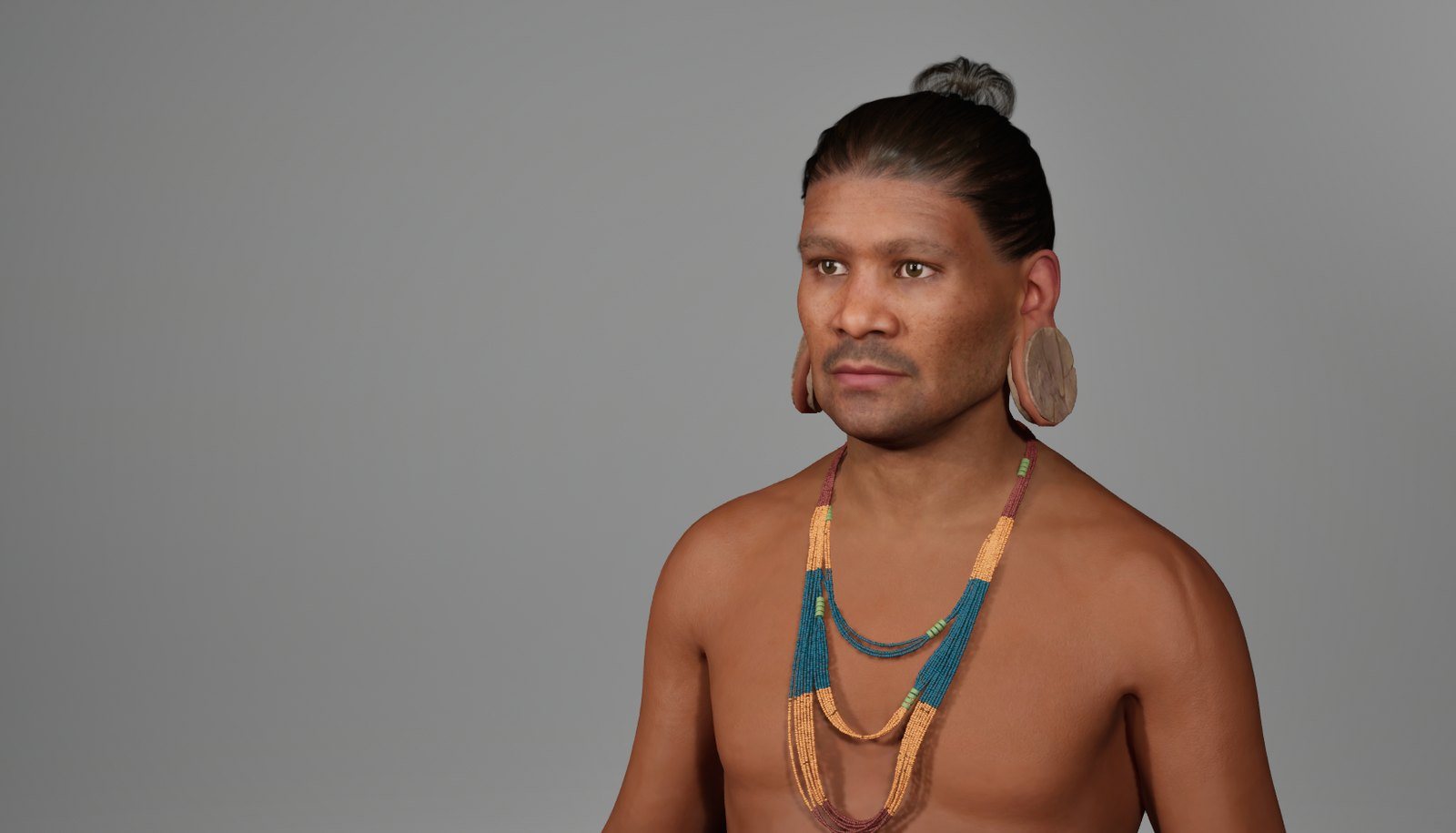
The finished reconstruction, rebuilt from 75 scanned skull fragments.
Key takeaways
- Visualskies 3D scanned 75 fragments of a roughly 1,000-year-old human skull from Site 75 at the Plain of Jars in northern Laos, for Discovery’s Expedition Unknown.
- Each fragment was captured with an Artec Spider structured-light scanner to an accuracy of 0.05 mm, in a field lab at the Xieng Khouang Provincial Museum in Phonsavan.
- The scans were reassembled into a complete digital skull, then the face was rebuilt from the inside out: muscle, fat and skin.
- Ear spools, tooth ablation and a beaded necklace were added from archaeological evidence, reviewed by archaeologist Nick Skopal.
Watch: from 75 bone fragments to a face in under 40 seconds.
A landscape of giant stone jars

The Plain of Jars covers the highlands of Xieng Khouang province in northern Laos. Nearly 2,000 stone jars sit across more than 120 sites. Each was carved from a single block of sandstone, and the largest weigh up to 20 tons. The sites were listed as a UNESCO World Heritage Site in 2019.
The people who made them left no writing. In the 1930s, French archaeologist Madeleine Colani found cremated human remains in about 20 jars and in a nearby cave. She placed the jar culture in the Iron Age, roughly 500 BC to 500 AD.
Later excavations found burials in the ground around the jars dating to nearly 1000 AD. That opened a new question: were these the jar builders, or a later people reusing an older site?
The region carries a modern burden too. During the Vietnam War era, more than 2 million tons of explosives were dropped on Laos, and unexploded ordnance still affects work around the sites today.
Bones inside a jar: the Site 75 discovery
Archaeologist Nick Skopal and his team found something nobody had recovered in over a century: human remains inside one of the stone jars. The jar sits at a site they call Site 75.

Fragments of a single skull from Site 75, as they arrived for scanning.
Unlike Colani’s finds, these bones were never cremated. They came from at least 37 individuals in a single jar and date to around 1000 AD. Nick’s theory is that bodies were first left outside until only bone remained, then reburied inside the jars, much like a family crypt.
The remains are too degraded for intact ancient DNA, at least so far. That left one other way to meet the people inside the jar: rebuild one of them digitally. That’s where VisualSkies came in.
| Site 75 at a glance | |
|---|---|
| Individuals in one jar | At least 37 |
| Approximate date | c. 1000 AD |
| Condition | Unburnt, fragmented |
| Fragments in the skull we scanned | 75 |
| Where the remains are held | Xieng Khouang Provincial Museum, Phonsavan |
Scanning 75 fragments in a museum field lab
Our co-founder Joe Steel set up a field lab at the Xieng Khouang Provincial Museum in Phonsavan. Viewers may remember Joe and Josh from an earlier episode, wedged together inside a tight space scanning a possible hidden tunnel near Egypt’s Great Pyramid. This time the subject was much smaller and far more fragile.

Our field lab at the Xieng Khouang Provincial Museum, set up for scanning on camera.
We followed a simple workflow:
- Catalogue. Every fragment was laid out on a taped grid, numbered and logged. Each digital model can then be traced back to a physical piece of bone.
- Scan. Each piece went onto a turntable under an Artec Spider structured-light scanner. As it rotates, the scanner pulses light 8 million times a second and records geometry to an accuracy of 0.05 mm, along with full colour texture.
- Capture the edges. The broken edges matter most. Their exact shape is what lets us work out, later, which pieces belong together.

Every fragment numbered and logged before scanning.
The mandible went first, then the many smaller pieces of the cranium. We also scanned an ear spool the team excavated during filming, so it could be used at its true size later.


The mandible on the turntable, and Joe scanning the smaller pieces.
Scanning in the field is the quick part. Processing the data and solving the puzzle took weeks back at our studio.
Solving the world’s hardest jigsaw
Back in the studio, the 75 scans became a 3D puzzle with no picture on the box. Software matched candidate pieces by shape and edge geometry. Our 3D team then worked through the fit by hand, checking each join against skull anatomy.

The skull taking shape as scanned fragments are matched.
Some of the bone was simply missing, mostly from the face. The skull is broadly symmetrical, so where one side survived we mirrored it to fill the gap on the other. The result was a complete digital skull, with every original fragment still in its true position.
That skull is the foundation for everything that follows. The face is only as accurate as the bone underneath it.
From bone to face, layer by layer
With the skull complete, we built the face the way forensic artists do: from the inside out.
- Muscle. In ZBrush, our 3D team sculpted the facial muscle groups directly onto the skull, following the attachment points on the bone.
- Fat. Fat pads were sculpted over the muscle. We kept him lean, in line with the archaeologists’ reference material.
- Skin. In Houdini, the skull and muscle were fitted inside a MetaHuman head in Unreal Engine. The skin was then shrink-wrapped over that structure, with detailed pores, freckles and eyes.

Skull, muscle, fat: the face built from the inside out.

The skull and muscle fitted inside the digital head.
Then came the details that make him a person from a particular place and time. Each one is based on evidence rather than guesswork.
| Detail | What it’s based on |
|---|---|
| Ear spools | Scanned from an ear spool excavated on the shoot and fitted at its real size. Stretching the earlobes to hold them showed us just how large they were. |
| Tooth ablation | The deliberate removal of healthy teeth. On Nick’s advice, the missing teeth are the two upper lateral incisors. |
| Beaded necklace | Built strand by strand in Houdini, with colours sampled from photographs of glass beads found in the jars. Those beads match ones produced in India, thousands of miles away. |
| Hair and teeth | A clean-shaven face with a simple top knot, and teeth that are slightly yellowed and uneven, following feedback from the archaeologist and producers. |

Tooth ablation and the ear spool, fitted at its real size.
Every stage went back to Nick and the production team for review. Several rounds of notes, on everything from the teeth to the hairline, shaped the final result.
Some choices, such as skin tone and hairstyle, are informed interpretation rather than hard data. We think that’s worth saying plainly. The structure of the face, though, comes straight from the scanned bone.
Face to face with a jar builder
We revealed the reconstruction to Josh and Nick on a video call. For the first time in over 1,000 years, someone could look into the eyes of a person from the Plain of Jars. Josh’s reaction: “This is insane.”

The face also raises a new question. Josh and Nick saw visual similarities with people they had met in Laos today, including the Khmu. The cultural echoes are there too:
- Tooth ablation was practised by peoples of southern Laos until about 100 years ago.
- Ear spools are still worn by elders in hill communities in the north.
- Beaded necklaces like the ones found in the jars are still worn across the country.
Could there be a genetic link between today’s Indigenous groups and the jar people? Nick’s team is now running ancient DNA testing to find out.
What 3D scanning makes possible
The fragments themselves never left Laos, and they never needed to. A careful scan captures them to a fraction of a millimetre, so experts anywhere can study, reassemble and visualise them without touching the bone again.
That’s what we do at VisualSkies, from shattered skulls to whole archaeological landscapes. If you’re working with heritage, museums or broadcast and want to see what 3D scanning could do for your project, get in touch.
“Death Jars of Laos” is Season 11, Episode 4 of Expedition Unknown.
More heritage and broadcast work from Visualskies: 3D scanning Petra’s hydrology, Lost Cities with Albert Lin and drone scanning for heritage preservation. For capturing people rather than bone, see what is cyber scanning?
Frequently asked questions
What is the Plain of Jars?
The Plain of Jars is a landscape of nearly 2,000 carved stone jars across more than 120 sites in Xieng Khouang province, northern Laos. Each jar was cut from a single block of sandstone, the largest weighing up to 20 tons, and the sites became a UNESCO World Heritage Site in 2019.
How old is the skull from the Plain of Jars?
The skull came from Site 75, where archaeologist Nick Skopal's team found unburnt human remains of at least 37 individuals inside a single stone jar. The remains date to around 1000 AD, making the skull roughly 1,000 years old.
How was the skull 3D scanned?
Each of the 75 fragments was scanned on a turntable with an Artec Spider structured-light scanner in a field lab at the Xieng Khouang Provincial Museum in Phonsavan. The scanner records geometry to an accuracy of 0.05 mm with full colour texture, including the broken edges used to match the pieces.
How do you reconstruct a face from a skull?
The scanned fragments are first reassembled into a complete digital skull, with missing areas mirrored from the surviving side. The face is then built from the inside out: facial muscles sculpted onto the bone in ZBrush, fat pads over the muscle, and skin fitted over the structure using Houdini, Unreal Engine and MetaHuman.
Which details of the reconstruction are based on evidence?
The face shape comes directly from the scanned bone. The ear spools were scanned from one excavated during filming, the tooth ablation follows the archaeologist's advice, and the necklace colours were sampled from glass beads found in the jars. Skin tone and hairstyle are informed interpretation.
Which Expedition Unknown episode features the Plain of Jars reconstruction?
The reconstruction appears in "Death Jars of Laos", Season 11, Episode 4 of Discovery's Expedition Unknown with Josh Gates.
Can 3D scanning help museums and archaeology projects?
Yes. A high-precision scan captures fragile objects and remains to a fraction of a millimetre, so experts anywhere can study, reassemble and visualise them without handling the originals again. Visualskies scans artefacts, remains and whole archaeological landscapes worldwide from London, Berlin and New York.