How Much Does It Cost to LiDAR Scan a Film Set?
Quick Summary — LiDAR Scanning Costs for Film & TV
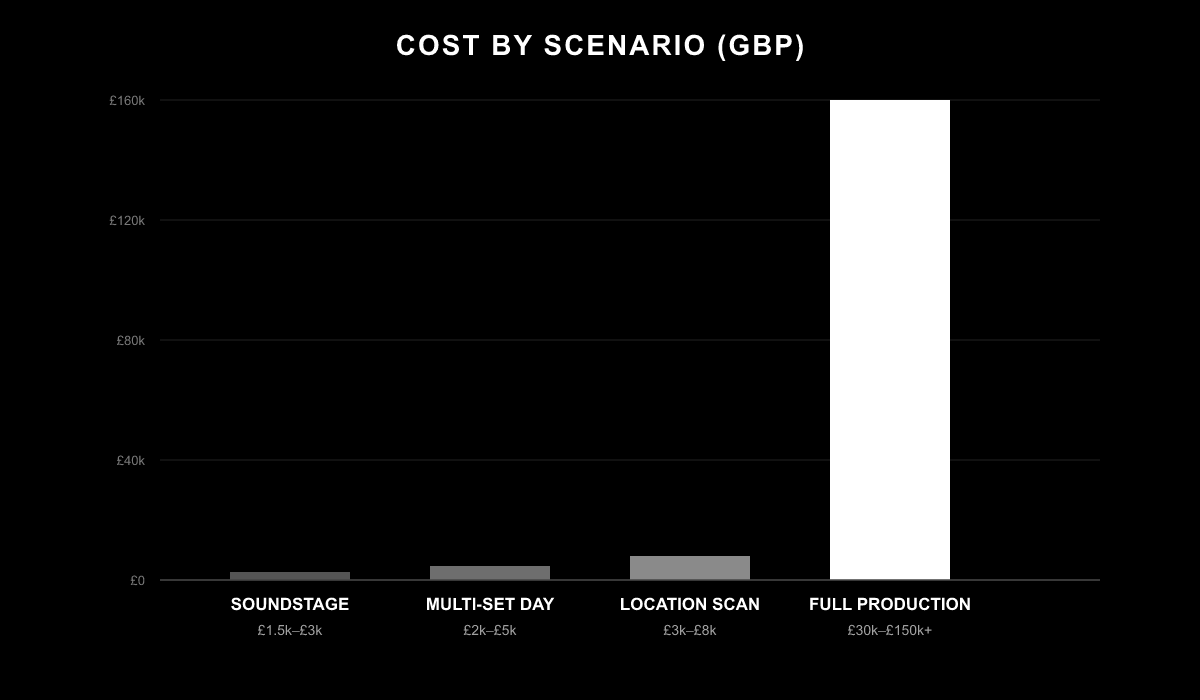
- Single soundstage scan: £1,500–£3,000 (half-day crew + basic processing)
- Multi-set studio day: £2,000–£5,000 (full-day crew + standard deliverables)
- Location scan (exterior/heritage): £3,000–£8,000 (full-day + aerial + extended processing)
- Full-production contract: £30,000–£150,000+ (ongoing shoot coverage)
- UK crew day rate: £1,000–£2,500/day. Rush delivery adds 25–50% to processing cost.
- Main cost drivers: deliverable complexity (point cloud → mesh → game-engine asset), turnaround time, surface difficulty, and location.
We get this question from almost every production we speak to. Usually it comes from a line producer who has been handed a VFX supervisor’s wish list and needs to know whether LiDAR scanning for film and TV is a £2,000 line item or a £20,000 one before the budget goes to the studio.
We’re a London-based studio and we cover shoots at Pinewood, Shepperton, Leavesden and locations across the UK, Europe (Berlin, Prague, Paris), as well as productions in Los Angeles, New York, Atlanta and internationally. Here’s how the numbers break down wherever you’re shooting.
What Goes Into the Cost of a LiDAR Scan
The price is never just “the scan.” It’s crew time, equipment, data processing, and the deliverables your VFX house actually needs. Understanding these components is the difference between getting a fair quote and getting an unpleasant surprise when the invoice arrives.
On-Set Crew and Day Rates
Most scanning companies quote by the day. A typical crew is one or two scanning technicians with their own kit. In the UK, that currently runs £1,000 to £2,500 per day — in the US it’s roughly $1,200 to $3,000.
That day rate usually covers:
- A trained LiDAR operator
- Scanner hardware (Leica RTC360, BLK360 or Faro equivalent)
- Tripod, targets and accessories
- On-set quality control and initial data checks
The operator matters as much as the scanner. On-set scanning is nothing like an architectural survey. There’s a call sheet, there’s turnaround time, and there’s a focus puller who will not wait while you set up another scan position. You need someone who’s been in that environment before.
Equipment Tier
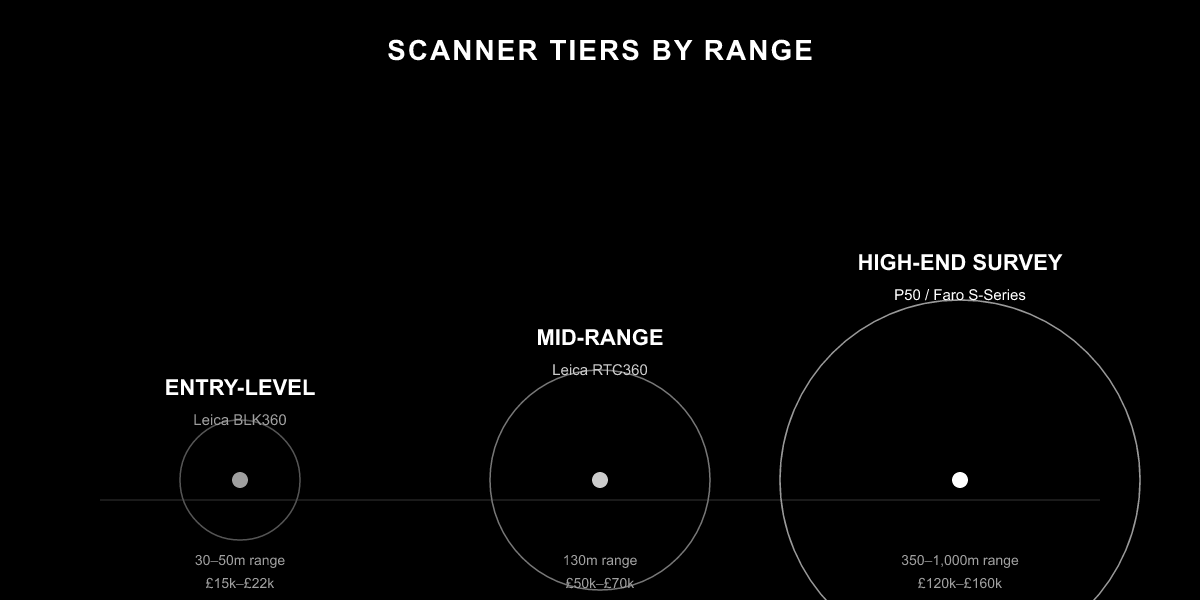
The scanner model affects accuracy, scan speed and — by extension — how long you need to be on set. Higher-end hardware covers more ground per position, which means fewer positions and less time in the way.
| Scanner Tier | Example Models | Range | Scan Speed | Purchase Price |
|---|---|---|---|---|
| Entry-level | Leica BLK360 | 30–50 m | 1–2 min/scan | £15,000–£22,000 |
| Mid-range | Leica RTC360 | 130 m | 2–3 min/scan | £50,000–£70,000 |
| High-end survey | Leica P50, Faro S Series | 350–1,000 m | 1.5–2 min/scan | £120,000–£160,000 |
You don’t need to buy anything. The scanning company brings their own hardware and it’s factored into the day rate. The BLK360 is a great compact unit for quick between-take captures — we used it on House of the Dragon for set coverage between setups — including Dragon Stone Bridge. The RTC360 is our workhorse for full set coverage; it’s what we’d bring for a standard UK studio soundstage brief.
Post-Processing and Deliverables
Raw point cloud data is only the starting point. The real cost variation is in what your VFX team actually needs delivered:
| Deliverable | Description | Cost Impact |
|---|---|---|
| Registered point cloud | Aligned scans in E57 or LAS format | Included in most day rates |
| Cleaned and meshed 3D model | Noise removal, hole-filling, retopology | +30–80% |
| Textured OBJ/FBX | Camera-matched textures applied to mesh | +50–100% |
| Game-engine-ready asset | Optimised for Unreal Engine or Unity | +80–150% |
| Full digital twin with HDRI | Complete environment with lighting data | +100–200% |
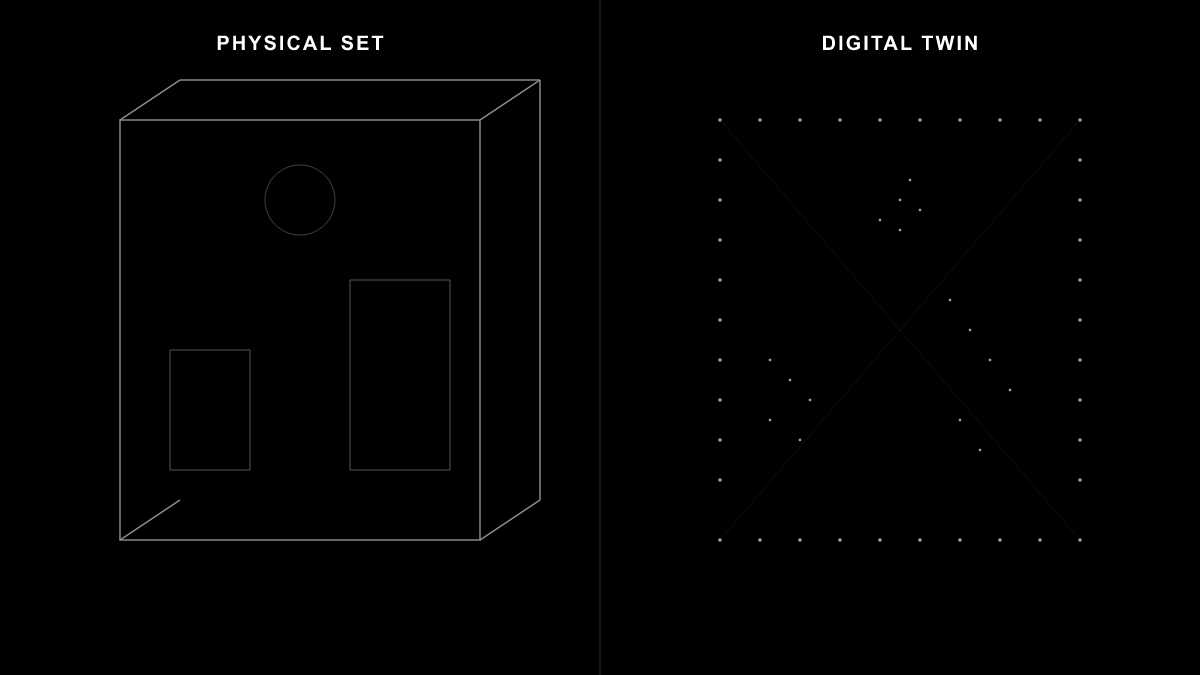
For a typical set extension brief, most VFX houses want cleaned meshes with textures in OBJ at low, medium and high resolution. If you’re going into an LED volume for virtual production 3D scanning work — converting scanned environments into real-time assets — you’ll need game-engine-ready output, which pushes processing cost higher.
Turnaround Time
Standard delivery is two to four weeks. Rush it and expect a surcharge of 25–50% on the processing cost. Same-day on-set QC — confirming coverage and data integrity before you wrap — is typically included in the day rate.
LiDAR Scanning for Film and TV: Typical Cost Scenarios
Every set is different. These scenarios give you a working ballpark for your budget, whether you’re shooting at a major UK studio complex or on location.
Single Soundstage Scan
A standard soundstage — at Pinewood, Shepperton or any equivalent facility — takes roughly two hours with a modern scanner. Each position takes two to three minutes; a typical stage needs 15–30 positions depending on complexity.
Multi-Set Studio Day
Larger productions book a scanning crew for an entire shoot day — multiple sets, backlot exteriors, standing sets. On House of the Dragon, the production used the RTC360 for full base scans of each set and the BLK360 for quick continuity captures between setups — including Dragon Stone Bridge.
Location Scan for Set Extension
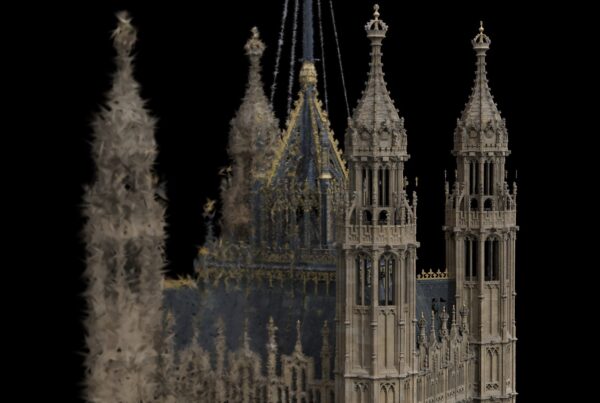
Exterior locations — streetscapes, heritage buildings, landscapes — need more scan positions and often aerial LiDAR or photogrammetry to cover rooftops and elevated geometry. On period productions like The King’s Man, the brief included scanning across multiple heritage locations — the kind of shoot where on-site time is tight and you don’t get a second visit.
Full-Production Scanning Contract
Blockbuster productions that need ongoing 3D scanning services across an entire shoot schedule negotiate a production-wide deal. On Napoleon, we captured over 100 locations, completed more than 3,000 cyberscans of people and props, and collected in excess of a million images. That’s not a day rate conversation — it’s a production partnership and better value for money.
The LiDAR Scanning Workflow
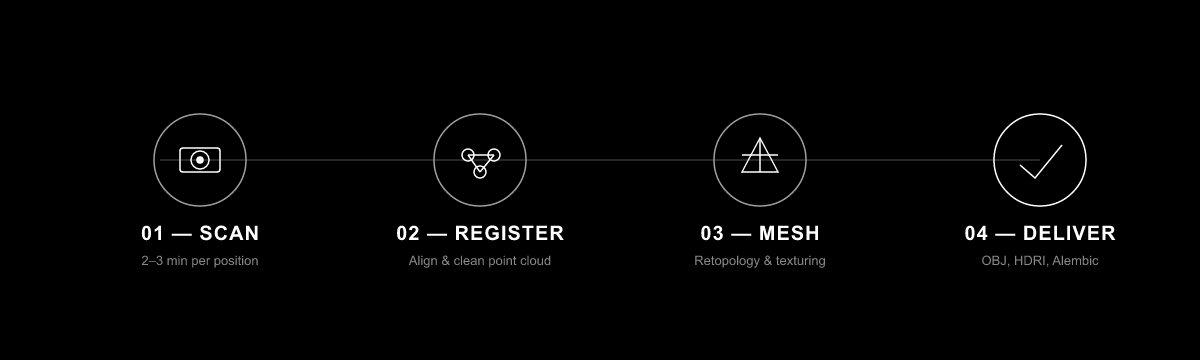
Every scan moves through the same four stages, regardless of project size:
Hidden Costs to Watch For
Travel and Accommodation
If your locations are across multiple cities or countries, crew travel and accommodation add up fast. International productions need to factor in flights, per diems and equipment shipping or carnet costs. We have operatives based in London, Berlin, New York and Hong Kong, which keeps costs down for productions spread across multiple territories.
Reflective and Problematic Surfaces
Glossy, dark or transparent surfaces — glass walls, chrome fixtures, wet floors — cause noise in LiDAR data and need additional scan time and post-processing cleanup. On Argylle, the spy thriller aesthetic meant glass walls, chrome fixtures and polished surfaces throughout — exactly the kind of set that causes LiDAR noise and adds hours to the processing pipeline. It’s worth flagging any problematic surfaces to your scanning provider before the day so they can plan for it.
Software Licensing
Some providers pass software costs through separately. Registration tools like Leica Cyclone Register 360 Plus carry substantial licence fees, and processing software like RealityCapture adds further cost if your in-house team needs to work directly with the raw data.
Storage and Data Management
A small set generates two to three gigabytes of raw scan data. A full production with hundreds of scans produces terabytes. Most productions maintain triple redundancy — encrypted SSD, location RAID and central VFX server. It’s worth asking your provider what their data handoff process looks like before you’re standing on set at wrap trying to get three terabytes off a hard drive.
Where LiDAR Scanning Saves Money
Fewer location revisits. A complete digital twin of a location means the VFX team can reference accurate geometry months after the shoot wraps, without sending crew back. That’s as true for a period manor house in Surrey as it is for a canyon in New Mexico.
Reduced post-production. Accurate 3D data means faster camera tracking, fewer manual modelling hours and less rework on set extensions. Productions consistently report LiDAR scans cutting matchmoving time by 50–70%.
Virtual production savings. A single LED volume production using scanned environments can save £400,000 to £4,000,000+ compared to building practical sets or transporting cast and crew to remote locations. The scan cost is a rounding error by comparison.
Pre-production confidence. Directors and DoPs can scout locations in VR, test lens choices and block scenes against millimetre-accurate geometry before a foot of film is shot. It changes the conversation on set.
How to Choose a LiDAR Scanning Provider
Not every scanning company has been on a film set. Whether you’re shooting at Pinewood, Leavesden, Shepperton or on location anywhere in the UK and internationally, the difference matters.
- On-set experience. Do they understand call sheets, turnaround schedules and what it means to be invisible during a take? A five-minute scanning window between setups requires a very different operator from a leisurely architectural survey.
- Deliverable format. Can they output directly into your VFX pipeline — Maya, Houdini, Unreal Engine — or will your team need to run conversion passes?
- Scanner quality. Construction-grade scanners achieve sub-millimetre accuracy over hundreds of metres. iPhone LiDAR is useful for a quick reference scan. It’s not a substitute on anything that matters.
- Turnaround commitment. Same-day QC and 24–72 hour delivery of priority assets is now standard among the better providers. If your prospective vendor can’t commit to that, it’s worth asking why.
- Combined services. The best providers offer LiDAR alongside photogrammetry, cyber scanning and HDRI capture — fewer vendors, fewer variables on your call sheet.
Need LiDAR Scanning for Your Film or TV Production?
Visualskies provides LiDAR, photogrammetry and volumetric capture for film, TV and virtual production. Based in London, available worldwide.
Frequently Asked Questions
How long does it take to LiDAR scan a film set?
A standard soundstage takes roughly two hours, with each individual scan position taking two to three minutes. A complex multi-level set might take half a day. Quick continuity captures between takes can be done in minutes with a portable scanner like the BLK360 — modern LiDAR scanners are silent and non-invasive, so the crew won’t even notice.
Can you scan a set while the crew is still working?
Yes. On House of the Dragon, we used the BLK360 for set coverage between setups without disrupting the crew. Lunch breaks and lighting setups are the natural windows, but a good operator can work around almost any schedule.
Is iPhone LiDAR good enough for film VFX?
For a quick on-set reference or emergency data capture, it’s better than nothing. But it’s not a substitute for a professional scan on anything that matters. Professional LiDAR achieves 0.3mm accuracy at 10 metres; iPhone LiDAR is roughly 10–20mm at range. In a VFX pipeline, that difference shows up.
Do I need LiDAR if I’m already doing photogrammetry?
The two are complementary. LiDAR captures precise geometry — photogrammetry captures high-resolution colour texture. Most film scanning providers, including us, use a hybrid approach: LiDAR for geometric accuracy and photogrammetry scanning for photorealistic texturing. You get production-ready assets faster and with less post-processing.
Where do you provide LiDAR scanning services for film and TV productions?
We’re based in London and work across all major UK studio facilities — Pinewood, Shepperton, Warner Bros. Leavesden and studio complexes in Cardiff, Manchester and beyond. We also cover international productions across the US (Los Angeles, New York, Atlanta), Europe (Berlin, Prague, Paris) and Asia Pacific through our Hong Kong team. If you’re shooting somewhere, we can get a crew there.
What file formats will I receive?
Standard deliverables include E57 or LAS point clouds, OBJ meshes at multiple resolutions (low, medium, high), HDRI environment maps and Alembic files. A good provider will deliver directly into your pipeline format of choice — worth confirming before the scan day, not after.