What Is Cyber Scanning?
Cyber scanning is the 3D capture of a person using a rig of synchronised cameras that all fire at the same instant. Around 150 photographs, taken in a fraction of a second from every angle, are turned into an accurate, textured 3D model of the actor in costume, hair and make-up. That model is a digital double: the starting point for stunts, crowds, face replacement and any shot a real person can’t safely or physically perform.
At Visualskies we design and build our own cyber scanning rigs and run them on set, on location and in our studios. This guide explains what cyber scanning is, how a digital double goes from camera rig to clean mesh, the different types of scan, and what VFX teams actually receive.
Key takeaways
- A cyber scan is a photogrammetry capture of a person, taken by a rig of synchronised cameras so the subject is frozen in one moment.
- Our head-and-body rig fires more than 120 cross-polarised cameras in milliseconds, and a typical scan is built from around 150 high-resolution photos.
- The photos are colour-calibrated, reconstructed into a 3D mesh, cleaned up and delivered as a production-ready digital double.
- Scans come in three main types: full body, head, and FACS facial expressions for animation.
- Our rigs are fully mobile and can be set up on set, on location or in a studio.
Watch: how a cyber scan becomes a digital double.
What is cyber scanning?
Cyber scanning means capturing a living subject in 3D, quickly enough that they don’t move during the capture. Instead of one camera walking around the subject, dozens of cameras are mounted on towers around a central space and triggered together. The result is a complete set of photographs of the actor from every direction, taken at the same instant.
In VFX the terms cyber scan, cyber, digital double scan, body scan and head scan are often used interchangeably. The name is generally traced back to Cyberware, whose laser head scanners were used on films in the 1990s. Today almost all cyber scanning is done with multi-camera photogrammetry, because it captures colour and fine surface detail as well as shape.

The Visualskies cyber rig: camera towers and programmable LED lighting around the capture space.
How does cyber scanning work?
Every cyber scan follows the same four stages, from the moment the actor steps into the rig to the clean digital double on the VFX vendor’s server.

How cyber scanning works, from camera rig to clean mesh.
- Capture. The actor stands in the centre of the rig in costume, hair and make-up. Every camera fires within milliseconds, locked together with microsecond accuracy, so there is no motion blur and no mismatch between views. The lighting is programmable, and the whole capture is over in a fraction of a second.
- Process. The photographs are colour-calibrated against charts captured in the same session, so the skin and costume colours are consistent across every camera. Cross-polarised lighting removes shine from the skin.
- Reconstruct. Photogrammetry software, such as RealityScan, finds matching detail across the images, solves the position of every camera and builds a dense, textured 3D mesh of the subject.
- Clean up and deliver. Our artists remove noise and stray geometry, fix areas the cameras couldn’t see, and prepare the asset for the VFX pipeline. Depending on the brief, that can include a retopologised base mesh, texture maps and a full library of facial expressions.


Camera towers, and a subject in position at the centre of the rig.
Why cross-polarisation matters
Skin is oily and reflective, and highlights move as the viewpoint changes, which confuses photogrammetry and bakes shine into the textures. Cross-polarisation puts polarising filters on both the lights and the cameras so the reflected glare is filtered out. What’s left is the true, flat colour of the skin (the albedo) and the pore-level detail underneath it, which is exactly what shading artists need to build a realistic digital human.
Types of cyber scan
Most productions need a mix of the three main types. They use different rigs and deliver different things.

Full body, head and FACS scans compared.
| Scan type | What it captures | Typical use |
|---|---|---|
| Full body | The whole actor in costume, hair and make-up, usually in an A-pose and a few action poses | Digital doubles for stunts, wide shots and crowds; costume reference |
| Head | Face, hair and neck at pore-level detail, from a dedicated portable head rig | Hero close-ups, face replacement, prosthetics and make-up design |
| FACS | A library of facial expressions based on the Facial Action Coding System | Blendshapes for facial animation, digital humans and games |
| 4D | A moving performance captured as a sequence of 3D frames | Reference for speech and complex expressions; volumetric content |
Props, costumes and animals can be captured the same way. For small objects we also run a dedicated object scanning rig.
See a cyber scan in 3D
This is a real full-body cyber scan from our rig, a performer in costume with a prop longbow, shown as a Gaussian splat you can turn around in your browser. Drag to rotate and scroll or pinch to zoom. The web version has been reduced to 1.2 million Gaussians to keep it light. The production data behind it is far denser, and is delivered alongside the photogrammetry mesh and textures.
What is a digital double used for?
A digital double is an accurate 3D replica of an actor. On a modern film or TV show it is used for:
- Stunts and dangerous action. Falls, explosions, vehicle crashes and fights that are unsafe, or impossible, for a performer.
- Zero gravity, flying and impossible camera moves. On Project Hail Mary, digital doubles helped put the cast into space.
- Face replacement. One actor playing twins, a stunt performer who needs the lead actor’s face, or a reshoot after the actor has left.
- Crowds. Scanned extras in costume become the building blocks for stadiums, armies and city streets.
- Costume, make-up and prosthetics. Accurate heads and bodies are used to design and fit pieces before the shoot.
- Games, marketing and virtual production. The same scans feed game characters, trailers, AR experiences and real-time engines.
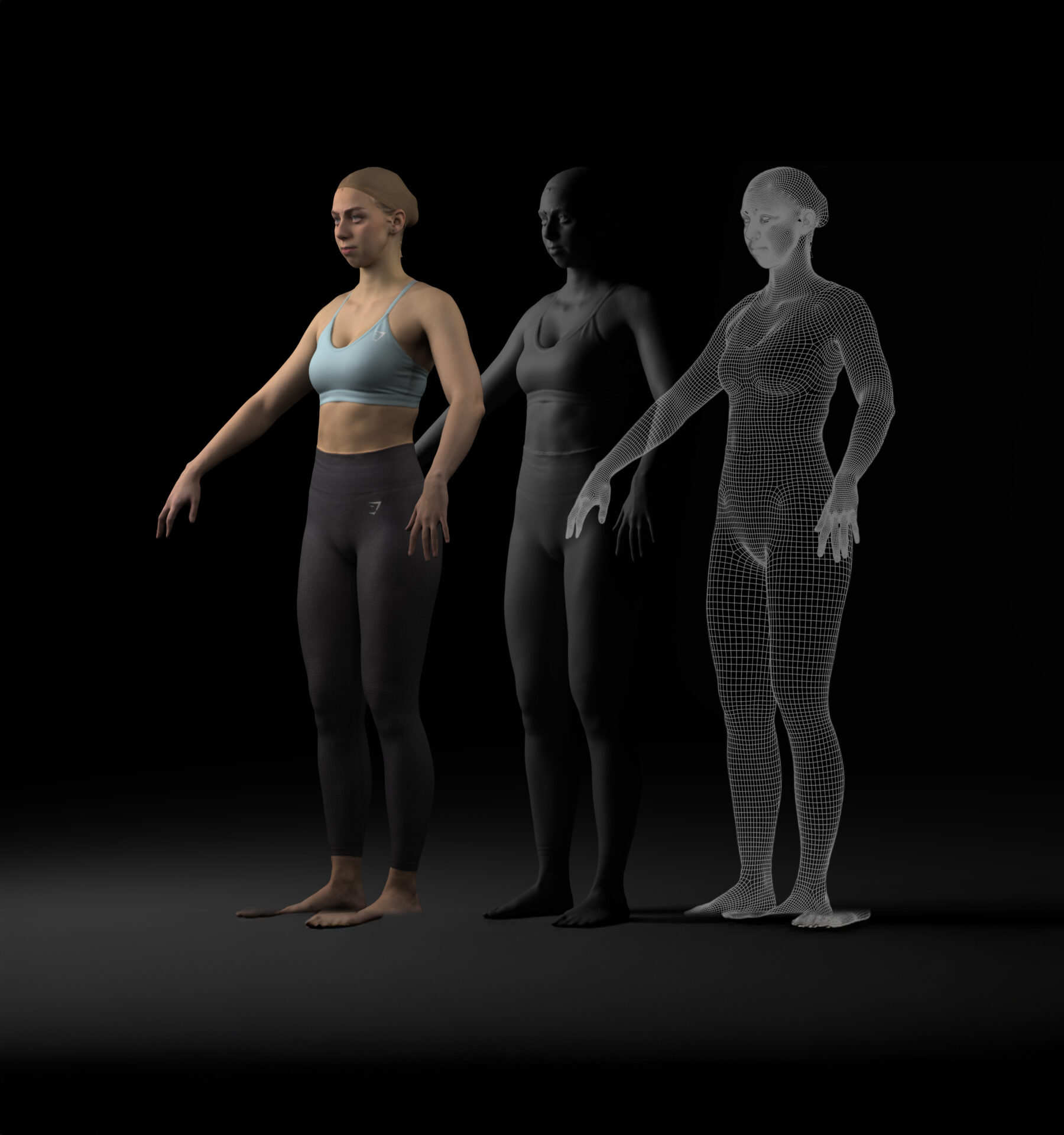

A digital double as texture, mesh and wireframe (left), and a finished character render from a scan (right).
What do you get from a cyber scan?
Deliverables are agreed with the VFX supervisor before the shoot. A typical cyber scanning delivery includes:
- The raw, colour-calibrated photographs from every camera, with the calibration charts
- A processed, textured mesh (OBJ or FBX) of each scan
- A cleaned, retopologised base mesh ready for rigging and animation
- Texture maps, including cross-polarised albedo and, on request, specular data
- FACS expression libraries and blendshapes for facial animation
- Gaussian splat previews for fast review; see what is Gaussian splatting?
Everything is named to the production’s conventions and delivered through our secure sharing platform, with contact sheets so editorial and VFX teams can find each look quickly. Cyber scanning is one part of our wider VFX scanning service.
How long does a cyber scan take?
The capture itself takes a fraction of a second. In practice, getting an actor into position, checking the pose and moving on takes under a minute per look, which is why cyber scanning fits around tight shooting schedules. Head and FACS sessions take longer because the actor works through a series of expressions.
Speed matters most on big casts, where every minute in the rig adds up across a long call sheet.
Cyber scanning on set and on location
Actors rarely have time to visit a scanning studio, so our rigs are designed to be packed down and shipped. We have set them up on studio lots, in production offices, in hotel rooms and on remote locations, with the same calibration and data pipeline wherever we go. You can read more about how we built them in Portable Volumetric Capture, Anywhere.

Inside the full-body rig: every camera points at the same capture space.
Cyber scanning on real productions
Project Hail Mary
On set we captured more than 100 cyber scans of the cast, alongside hundreds of props and environments, to support the film’s zero-gravity sequences and digital extensions. Read the story.
Another Simple Favour
We took our mobile full-body and FACS rigs to Cinecittà Studios in Rome to scan cast members including Blake Lively and Allison Janney, capturing more than 20 facial expressions and multiple make-up and costume looks for the film’s twin characters.
Cleaner
Our mobile head rig went to Winnersh Film Studios to capture head and FACS scans of the cast, including Clive Owen and Daisy Ridley.
The Devil’s Mouth
We provided on-set cyber scanning in Thailand, capturing the cast as high-resolution digital doubles from a mobile rig in the heat of location shooting.
Madden NFL 26
We scanned players in New York and delivered optimised, retopologised and rigged meshes for the game’s next-generation character pipeline.


Project Hail Mary and Another Simple Favour.
Is a cyber scan the same as an AI clone?
No. A cyber scan is a still, highly accurate measurement of how a performer looks at one moment. It records shape and surface. It doesn’t capture a voice, a performance or how someone moves, which is what generative AI models would need. We explain the difference in detail in our Project Hail Mary article.
What performers rightly want is clarity about their data: who holds it, where it’s stored, what it can be used for and when it’s deleted. We handle scan data under the production’s agreements, store it securely and share it only with the teams the production names.
Cyber scanning in London, Berlin, New York and worldwide
Visualskies runs cyber scanning from bases in London, Berlin, New York, Italy and Hong Kong, and our mobile rigs travel to productions anywhere in the world. In the UK we regularly scan at Pinewood, Shepperton, Warner Bros. Studios Leavesden and studio complexes across the country.
- Cyber scanning London: Unit 4S Hewlett House, 5 Havelock Terrace, Battersea, London SW8 4AS, United Kingdom
- Cyber scanning Berlin: Wilhelminenhofstraße 92, 12459 Berlin, Germany
- Cyber scanning New York: 546 West 48th Street, New York, NY 10036, USA
Recent cyber scanning work has taken us to Rome, Thailand, Berlin, Hong Kong and New York, as well as studios across the UK.
Frequently asked questions
What is cyber scanning?
Cyber scanning is the 3D capture of a person using a rig of synchronised cameras that all fire at the same instant. Around 150 photographs from every angle are turned into an accurate, textured 3D model of the actor in costume, hair and make-up, known as a digital double.
What is a digital double?
A digital double is an accurate 3D replica of an actor made from a cyber scan. VFX teams use it for stunts, zero-gravity and impossible camera moves, face replacement, crowds, costume and prosthetics design, games and marketing.
How many cameras does a cyber scanning rig use?
Visualskies' head-and-body rig uses more than 120 cross-polarised cameras, synchronised to fire within milliseconds. A typical full-body or head scan is built from around 150 high-resolution photographs.
How long does a cyber scan take?
The capture itself takes a fraction of a second, and an actor is usually in and out of the rig in under a minute per look.
What is a FACS scan?
A FACS scan captures a library of facial expressions based on the Facial Action Coding System. The expressions are used to build blendshapes so animators can drive a realistic digital face.
Why is cross-polarised lighting used for face scanning?
Skin is oily and reflective. Cross-polarisation filters both the lights and the cameras to remove glare, so the scan records the true flat colour of the skin (the albedo) and its pore detail, which is essential for realistic digital humans.
Is a cyber scan the same as an AI clone?
No. A cyber scan is a still measurement of a performer's shape and surface at one moment. It does not capture a voice, a performance or how someone moves, which is what generative AI models would need.
Can you cyber scan actors on location?
Yes. Visualskies' cyber rigs are fully mobile and have been set up on studio lots, in production offices, in hotel rooms and on remote locations. The company has bases in London, Berlin, New York, Italy and Hong Kong.